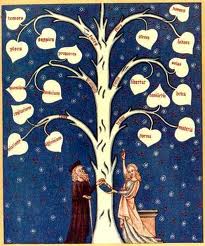
I am now studying the literature of the Iberian Peninsula so as to teach it and there is a lot to know that I did not. Ramón Llull knew classical Arabic and wrote his first book and other texts in it, for instance; he had learned Arabic so as better to convert the infidel, just as other Christians would soon learn Mayan. The book reads like this in Catalan but I would like to see the Arabic manuscript. Here is an image from his 1296 book, The tree of knowledge:
Axé.
 coldhearted scientist وداد
“Los joglars veem, Sènyer, que de nit van sonant los estruments per les places e per les carreres, per tal que moven lo coratge de les fembres a puteria e que facen falsia e traïció a lurs marits…”
Wow, just wow. You gotta love medieval misogyny. It’s a surreal vision of troubadors playing devilish music to make women not be able to tell the difference between one man and another.
Does he really say that about not being able to tell the difference, though?
Los malvats joglars veem, Sènyer, ésser maldígols e malmescladors enfre un príncep e altre, e enfre un baró e altre; e per la mala fama que sembren los joglars, e per l’odi e la mala volentat que engenren enfre.ls alts barons, per ço veem destruir emperis e regnats, e comdats e terres, viles e castells.
The evil troubadours, come, Lord, to be malas lenguas and create strife between one prince and another, and between one baron and another; and by the mala fama the troubadours sow, and by the hatred and ill will they engender among the high barons, this way the come to destroy empires and kingdoms, and counties and “terres” [marches? fiefdoms?], hamlets and castles.
I was referring to the next part:
Los malvats joglars veem, Sènyer, ésser maldígols e malmescladors enfre un príncep e altre, e enfre un baró e altre; e per la mala fama que sembren los joglars, e per l’odi e la mala volentat que engenren enfre.ls alts barons, per ço veem destruir emperis e regnats, e comdats e terres, viles e castells.
I took baró for varón but I am not sure Malmezcladors is an interesting word.
That’s the piece I just translated! Castilian varón is Catalan varó. I’ve now looked it up to be sure but you can tell baró is baron by parallelism, he’s talking about princes, castles, etc., not just men.
Yes, I love malmesclador; I decided it must mean creator of strife but I did not look it up.
“malmesclar” is “Posar mal, enemistat, (entre dues o més persones)” so you were on track. I hit enter too soon on my comment so I didn’t realize you had just translated that.
I will use malmesclar in every Romance language I can from now on! It is a highly useful word and colorful.
I have not figured out what “terres” are in English specifically.
Terres is plural of terra, earth, soil, land, country, etc… In Spanish I would say “imperios y reinos, condados y tierras, aldeas y castillos.” It may have a more precise and specific meaning here.
But, what about English? This is the difficulty I keep having, going to non Romance.
…I really like that image, though, of the troubadours coming by night to sound their instruments on the squares and streets. Those medieval nights would be so quiet, and then here would come the troubadours, sneaking by corners of buildings and making noise with those rebecs and things … http://crab.rutgers.edu/~pbutler/rebec.html#2