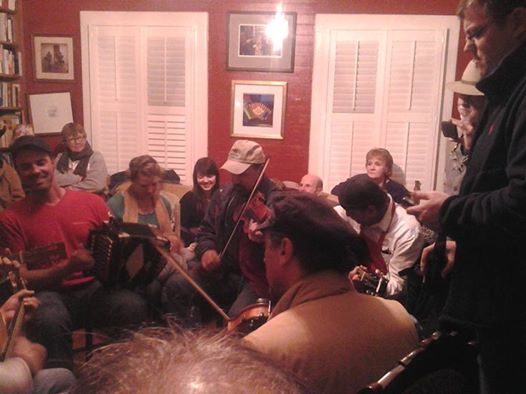
That is a picture from our annual cochon-de-lait. I went there, then came home and read fifty pages of literary history. In the morning I woke up again without having to talk myself into facing the day.
Someone told me about these motivational tricks, the idea being to keep them in mind when planning teaching. This is worth looking into.
Bad approach #1: Present information and hope it leads to attitude change and then behavior change.
Bad approach #2: Give people a big goal and then focus on amping motivation or sustaining willpower.
Bad approach #3: Move people through psychological stages until they are ready to change.
Bad approach #4: Assume all behaviors are the result of choices.
Bad approach #5: Make persuasion techniques, such as scarcity or reciprocity, the starting point for your solution.
In So Many Words quotes this, from here, and I will put it in my syllabus … and perhaps send to faculty as well:
Assimilating concepts often requires engaging multiple perspectives on the same information — multiple theories about the same musical concept, multiple ways to perform the same kind of passage, etc. It also requires attempts at applying the material, such as composing, analyzing, or performing. These things are harder than taking notes and regurgitating them on a test, and often take longer than a single class meeting or homework assignment to figure out. For those of you who are used to courses that “test early and test often,” this may be uncomfortable and may feel, initially, ineffective. However, doing hard things and working to apply concepts leads to deeper, longer-lasting learning than lecture, baby-step homework, and a test you can cram for.
Also:
First, education is more than the transfer of information. Education involves the transfer of information, of course. However, there are things more important, and more difficult, than simply memorizing information. In our class, those things include the assimilation of concepts and the application of those concepts in musical activities. . . . For those of you who are used to courses that “test early and test often,” this may be uncomfortable and may feel, initially, ineffective. [However, doing hard things and working to apply concepts leads to deeper, longer-lasting learning than lecture, baby-step homework, and a test you can cram for.] That’s a big reason that I rarely lecture and don’t use workbooks: we need to do hard things and engage multiple routes through the material in order to truly understand and master it.
#OccupyHE
Axé.
 coldhearted scientist وداد